Farewell, Gino September 6, 2016
Posted by dorigo in physics.comments closed
Gino Bolla was an Italian scientist and the head of the Silicon Detector Facility at Fermilab. And he was a friend and a colleague. He died yesterday in a home accident. Below I remember him by recalling some good times together. Read at your own risk.
Dear Gino,
news of your accident reach me as I am about to board a flight in Athens, headed back home after a conference in Greece. Like all unfiltered, free media, Facebook can be quite cruel as a means of delivering this kind of information, goddamnit.
I did shed a few tears for you under the sunglasses I was quick to put on, as I queued up in front of the gate. But then I felt a bit silly, thinking that in fact, the pain we feel in these situations can be a bit selfish. Was I weeping for you, for a beautiful life meaninglessly interrupted, for your great wife and marvelous kids who must now feel like they were ripped off a big chunk of their heart, and stolen many more years of happiness together? Or was I weeping for myself, thinking that some of the things we did together -a few fun moments of our life- have no other witness now, and will never be recalled again together in front of a beer or a glass of unnecessarily expensive wine? In earnest I do not know, and the thought is quite disturbing to me. So I will leave it alone, and rather make an effort to recall those moments together one more time, as my own way to say good-bye to a friend, or maybe to share them with whomever else had you in their heart.
When we first met, in 1993, you had just finished your military service, as a paratrooper. We were both working at our undergraduate theses then, and shared an extra “students office” that Dario had managed to get assigned to his group, at the second floor of the Department of Physics. That room does not exist anymore, and the physical space is now the office of Matteo and Fulvia; but as I pass by I sometimes remember that time, with a mixture of feelings. Now the mixture will be a bit harder to cope with.

I remember I did not like your attitude at first: you sounded too much of a smart-ass, alpha-male kind of guy. You never missed a chance to have fun of me for things I did or for my way of dressing. No style! You were of course right. And I rapidly got used to it, and for the next 23 years I never allowed your attitude to get on my nerves. I hope you can acknowledge that, dear Gino: I allowed you all the freedom you wanted on having fun of me. Once that bit of our interaction got fixed, we had a good time together as undergraduates. In truth, I would not say we became friends back then: not yet. Despite the laughs, the obnoxious jokes, and the constant hilarious swearing while we coded top quark search algorithms or silicon detector notes, we did not have the time to build a real connection; we only spent time together at work, and we lived in different towns.
Things changed when we met again at Fermilab, you with a post-lauream position to develop silicon sensors for CDF; and me working at my PhD on data analysis for the same experiment. The topics of our work activities never crossed, but sharing the same apartment at Brookdale, spending evenings cooking some fancy recipe you wanted to try, and going to bars in downtown Chicago, were all ways to connect. You usually kept that smart-ass attitude with me -that was a character trait that people who met you either loved or hated (I must be among the very few who hated it ahd loved it at the same time); but then there were moments when you would speak to me quite frankly about anything: your family, your father who left as prematurely as you now did, your early affairs, your motorbike adventures. I think you did realize back then that I was somebody you could count on, and I may have surprised you for never taking a chance to get even with you on the jokes.
 You had a big heart, but you did not make a big deal of it. Sometimes you concealed this character trait of yours; but it was bound to emerge at some point. You were not a saint, though. Apart from not liking some of your political ideas, a bit too conservative for my taste, I had some concerns with the somewhat retrograde way of considering women you at times made explicit in words more than in acts. Or maybe it was just a joke. Or maybe it was just me.
We spent a lot of time together in the US. I remember countless evenings in the late 1990s, when you came to visit me and Mariarosa and cooked with us or for us. After dinner you would teach me Bridge, making fun of my poor understanding of the game, but teaching me a lot in the process. Or you would join us playing with my son Filippo, who was barely one year old then. I also remember when we tried to bake a créme brulée, and failed miserably! It must have been my oven not working properly, as your cooking skills were well above average. That evening we made up with that and consoled ourselves with ice cream, then got drunk with too much beer. Or rather, I got drunk, you did not; damn it, you could drink four times as much as I did without any apparent effect, if not a slight tendency to let your character traits take over a bit. Then while I would be condemned to a night of headaches and nausea, you would just crash on whatever flat surface around, with no apparent side effect.
Another time I was home alone and I insisted to have you come over. I cooked for you and two technicians you originally wanted to bring to a restaurant, to commemorate some achievement at the lab. When I served a lobster dinner to all you looked genuinely impressed, and later thanked me heartily, explaining that it had been very important for you that your guests had felt welcome and treated in the best possible way. In that occasion I got a hint that you always showed appreciation for the work of your collaborators and tried to treat them well. This is also an input I got from many other sources. At work everybody seemed to like you, Gino. What was it?
When you met Petra, who later became your wife, I thought it was a real piece of luck (and I still do). I had known her in 1996 at a Summer School in Stanford, and later she had moved to Fermilab. The moment I saw her with you I realized you were meant to be together! She had the balls to keep up with you, and the patience to be your lifetime companion. And as a physicist, one at least as good as you, this was a good way to suppress your slight gender bias. What was it, 1999? The timeline looks a bit blurred now, especially since I just drunk a quarter-liter of white wine while I’m sitting on my flight to Venice now. I drank it as if we were together – but I guess you would have had quite a bit to say about the quality of the wine served by Aegean. Yet I kind of liked it, as it brought back some more memories of our times together.
 When I moved back to Italy our chances to meet decreased, but in fact the quality of our interactions increased. In 2005 we visited you at your house in Lafayette for my daughter’s second birthday, and we spent a perfect weekend together. In 2006 you came to Padova and invited us over to your mother’s house in Villatora -you always claimed it was the best place in the world, and at times I thought you really meant it. We picked apples from the trees of your neighbor’s garden, and while we ate them we started fantasizing about a trip to some exotic beach together. That thought concretized just a few months later, when we spent an absolutely fabulous 10 day vacation in Yucatan. Villa Margarita, a private beach in Soliman bay, the morning swim to greet the moray on the rock in front of our house, and the swims together to the reef and back. I remember I got you angry at me once, as you had planned to see a movie together after dinner, while I lingered in front of the house watching the night sky with our neighbor. Sorry, Gino – you know I’d always prefer the night sky to a movie, but that evening I made a mistake.
And then we had more occasions to get pissed off at one another, but it never really happened. Instead we always got along well, despite being two quite different fishes. In 2008 you came to Padola with Petra and the kids, and we skied and spent a few nice days on the snow. And in 2009 you again came to Italy with your family at the right time to participate to my daughter’s sixth birthday party. I remember that Anna lost a toy earring under my sofa that day, but we got it back to her… Ilaria (my daughter) must also remember very well when I brought her to your beautiful house in Echenevez. We felt at home there, as always with you guys.
And then we sort of stopped this habit of getting together in spite of the distance (your family at CERN, mine in Italy). That was due to my separation from my wife, something you never understood. How cruel can life be with us, Gino – you criticized me for leaving my family, and now an accident makes you do the same with yours. You did not deserve that, nor did they.
In the last few years we only spoke a few times. We had dinner together in Miami and Aix-les-Bains two years ago, and I found you still critical of my personal life choices, but more willing to forgive them and to share a few drinks (a few Piscos too many for me in Miami – I had forgotten just how much you can outdrink me, doh!). Now I do not know if you really counted me as a friend, Gino, but you were one to me. And now I miss you, damnit.
Blogs You Should Read February 8, 2016
Posted by dorigo in physics.comments closed
As you can easily verify by checking the post date on the articles in this column, this blog is nearly inactive. It used to be the main site of my blogging activities from 2006 to 2009. In april that year I transfered my activities to www.science20.com , where I have been blogging since then. You can visit that site to keep informed of what is going on in the field of High-Energy Physics – you know, subatomic particles, fundamental physics, the Large Hadron Collider, and the like. All for laypersons, with some occasional plunges into more technical discussions.
Another blog I am contributing to since December 2015 is the one at amva4newphysics.wordpress.com, which is a collaborative column maintained by the participants to the AMVA4NewPhysics network, a Innovative Training Network funded by the European Commission under the “Horizon 2020” program. The network members are 15 universities, research institutes, and industries united by the common goal of providing an innovative training structure for PhD students who want to learn cutting-edge statistical learning tools while doing research in particle physics with the ATLAS and CMS experiments at the CERN LHC collider. The web page of the network is here. In the network blog you will find information on advanced classification and regression algorithms applied to particle physics problems, as well as discussions on science topics of the liking of the students enrolled in the network, who are the main contributors to the column.
Finally, if you can read Greek, there is another blog that I started five years ago, where I wrote a few posts about particle physics in that language. The blog has been maintained by a collaborator for a few more years, but I think the posting rate has significantly decreased recently. I will make an effort to keep that endeavour going, but it looks harder.
As for this blog, it will remain active with very scarce posting rate. As this site contains a lot of good reading material, much of it still valuable and not outdated, I think there is value in keeping it alive.
Tommaso Dorigo, February 2016
Searching for the A boson with CMS November 22, 2014
Posted by dorigo in physics.comments closed
I am quite happy to report today that the CMS experiment at the CERN Large Hadron Collider has just published a new search which fills a gap in studies of extended Higgs boson sectors. It is a search for the decay of the A boson into Zh pairs, where the Z in turn decays to an electron-positron or a muon-antimuon pair, and the h is assumed to be the 125 GeV Higgs and is sought for in its decay to b-quark pairs.
If you are short of time, this is the bottomline: no A boson is found in Run 1 CMS data, and limits are set in the parameter space of the relevant theories. But if you have a bit more time to spend here, let’s start with the beginning – What’s the A boson, you might wonder for a start.
The A particle is one of the five physical states resulting from the breaking of the electroweak symmetry by the Higgs mechanism, when instead of the minimal insertion in the standard model Lagrangian of a single complex doublet of scalar fields, one inserts two such doublets. The Higgs mechanism works quite similarly: instead of having plugged in four degrees of freedom with the complex doublet, three of which get absorbed by the positive and negative charged W and the Z boson, which all get mass terms in the Lagrangian, and one remains as The higgs boson, we have inserted eight degrees of freedom, so we expect five higgs-like new states to appear.
Of the five higgses of two-doublet models, there are one positively and one negatively-charged one, two more scalars – the h and the H – and the pseudoscalar A. In the analysis it is assumed that h is the particle we found at 125 GeV two years ago. This typically makes the A heavy, although the space of parameters is quite complex and the phenomenology quite varied. As past searches of the A at lower energy have failed, the analysis concentrates on a mass range where the Zh final state is a possibility for the A disintegration: so the A is supposed to be heavier than 216 GeV -the total of Z and h masses.
CMS has collected 20 inverse femtobarns of proton-proton collisions at 8 TeV, and in that data sample there are tens of millions of Z boson decays to ee or μμ pairs. It is exactly there that the search starts. Then, two b-quark-tagged jets are sought in addition; the mass of the two b-jets is required to be close to 125 GeV; and a multi-variate algorithm is used to distinguish the selected data from backgrounds.
Data selection starts from millions of collision events and ends up with a sample of few thousands of them, where a possible A signal would be more easily seen. The initial selection includes two leptons from Z decay, then two jets events are kept, then only ones where the jets are b-tagged, and finally a cut is placed on the output of a multi-variate algorithm (a BDT, boosted-decision trees) which distinguishes data from backgrounds using the distinctive features of the A decay kinematics.
As the two leptons and the two b-jets are supposed to come from the decay of a single particle, the four-body mass is the most distinguishing variable to look at. However, if you just combine the mass of the two leptons and two jets your mass resolution will be good but not great: jet energies, in particular, suffer from a 10% relative resolution which smears a bit the resulting peak from a resonance decay. What is done in the analysis is to fit the four 4-momenta to the hypothesis that the leptons come from the Z and the b’s come from the decay of the 125 GeV higgs. This “pulls” measured energies and momenta in the right direction and the final result is that the resolution on the four-body mass shrinks quite spectacularly, as you may check in the graph below.

You can see several mass peaks, relative to different mass hypotheses for the A boson, before (dashed curves) and after (full curves) the application of the kinematical fit. It is clear that this strongly improves the chance to observe a signal in the data, especially if there is a large background -mostly due to Z+bb production and top production.
One of the nice things about the analysis is that in the final data sample all contributing backgrounds are tightly constrained in normalization from a global fit to a number of control regions simultaneously. There are control regions that specifically select top-rich events, Z+bb-rich events, Z+b-rich events, e.g.; so the fit is capable of correcting the simulation prediction for the yield of each of them. Below, for instance, is the missing ET distribution of the control region rich in top-pair decays: you can see that the yellow top contribution dominates the data, so a match of data and simulation in this control region strongly fixes the top contribution.

In the end, the search for the signal is performed in the two-dimensional plane of 4-body mass and BDT output. This makes less easy to display the fit result, but one can produce projections, e.g. in the mass distribution. As the search is performed in a wide mass range, and the kinematics of the decay is strongly dependent on the A mass, three different BDTs are trained to select the signal. For the central mass region this is the mass projection:
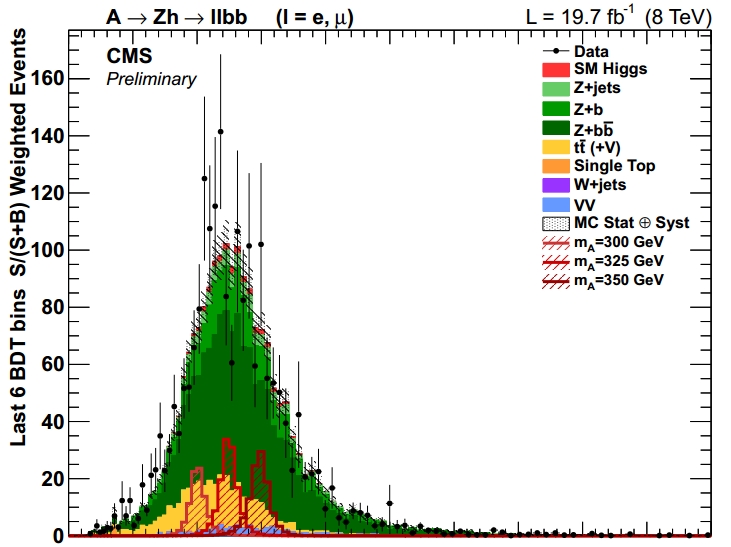
If you are wondering about the few high bins near 320 GeV, well, that’s a 2-sigmaish fluctuation, an effect which is entirely expected given the number of mass points that are independently investigated by the search. The result of the search is that there is no A boson in the data. Upper limits are derived in the context of two-doublet higgs models, and a series of such limits are obtained in the parameter space of the models. I refrain from showing those, as you can only appreciate them if you are an expert, and in that case I strongly suggest that you download the public CMS document describing the analysis, by paying a visit to the public web page of the analysis.
Standard Model or Minimal SUSY ? April 6, 2014
Posted by dorigo in physics.comments closed
(I posted the text below in my current blog, which is at this link; I post it here as well as I would like to keep this blog active by writing something here now and then – TD).
If I look back at the first times I discussed the important graph of the top quark versus W boson mass, nine years ago, I am amazed at observing how much progress we have made since then. The top quark mass in 2005 was known with 2-3 GeV precision, the W boson mass with 35 MeV precision, and we did not know where the Higgs boson was, or if there was one.
Today, the top quark mass is measured with a 770 MeV uncertainty and the W boson mass with a 15 MeV uncertainty. That alone is a reduction of a factor of 10 in the allowed phase space of those two parameters; but crucially, we no also know the Higgs mass with a 0.5% accuracy. This leaves very little space for the true parameters of the standard model. On the other hand, if the SM were to be enlarged to a minimal version of Supersymmetry, then the theory predictions would blow up considerably, as the MSSM allows much more freedom to those parameters as others (like squark masses) are varied.
The summary of the experimental situation is shown in the graph below, which Sven Heinemeyer produced today for this blog (thanks Sven). The graph summarizes calculations produced by Heinemeyer and his colleagues Hollik, Stockinger, Weiglein and Zeune. In the graph the horizontal axis shows possible values of the top quark mass, in the very restricted range allowed by the latest world’s best CMS measurement; the vertical axis shows values of the W boson mass, in an even narrower range in absolute terms, thanks to precise measurements of that quantity performed by LEP2 and the Tevatron experiments. The experimental determination of those two parameters is symbolized by a grey ellipse which encompasses 68% of their probable values.

Then if we stay within the standard model, the Higgs boson mass measurements by the CERN experiments (+-0.7 GeV) force the two parameters to be bound to lie within the very narrow red line; if instead we take the MSSM as the true underlying theory, the whole green area is possible; different points of this area correspond to different value of other parameters (here a more liberal variation of the Higgs mass is taken, to cover more possibilities). The downward arrow symbolizes that as one increases the “mass scale” of the MSSM the allowed region moves closer to the SM line.
Note that in this graph the grey ellipse and the red line are the only experimental inputs; there is no “LEP indirect” oval here, as this would be too wide for the graph. In other words, the precision electroweak information from the Z boson studies of the nineties has become largely irrelevant in this particular view (it remains a formidable input to verify the general agreement of SM and data, if one studies other parameters).
So, what should we carry home from this graph ? I believe at least two things. One, that the SM likes the W mass to be a bit lower than what is currently measured, and the top quark to be a bit higher; the tension is however only mild -we are talking about just a bit more than one standard deviation for the disagreement. Two, that the MSSM is not killed by these measurements – it would live on regardless of the precise values of W and top masses, as the breadth of the green area shows.
Oh, and a third thing – the experimental measurements of these quantities rock!
Other considerations can be made, but I will stop here for tonight. Tomorrow I will be on a train at 6 in the morning, to participate in a 2-day open discussion organized by INFN in Rome, called “WHAT NEXT”. A very interesting discussion on the long term plans of italian research based on the current status of particle physics, astrophysics, cosmology, and other fundamental investigations. I will have something to report on that later on…
Devotion to the Tevatron October 2, 2011
Posted by dorigo in physics.comments closed
(This post first appeared on my current site, www.science20.com/quantum_diaries_survivor . Please note that I post on this site quite rarely. Please visit me on the science20 site for updates on experimental particle physics and more!).
I’m nostalgic tonight. The reason ? The Tevatron has finally stopped running, for good.
It’s strange to find out one can mourn the shutdown of a synchrotron just as the passing away of an old friend, but that’s more or less how I feel like tonight. And I am not even among the ones who can claim to have been around for the full duration of the machine’s lifetime, like Giorgio Chiarelli – as Giorgio recounted here, he was there in the CDF control room when the first proton-antiproton beams collided the first time, in 1985.
I started working in CDF in June 1992. In the course of these 19 years I have learned all I know about particle physics, and I have met a large number of extraordinary people. Not only ones from CDF: the Fermi laboratories are of course a place where you interact with the “competitors” from the other experiment, DZERO -you work elbow to elbow, go to the same parties, seminars, and events, and you share joys and frustrations as the machine which feeds data to both experiments outperforms or suffers technical stops. Plus of course technicians, machinists, administrative staff: a number of people who simply did their job there, but who all shared the pride of doing their part for the success of this remarkable human adventure.
As Gary Taubes explains in juicy details in his book “Nobel Dreams” (1987), it was Carlo Rubbia in the late seventies who first launched the idea of a proton-antiproton collider at Fermilab. Back then, he got severely beaten up by the lab director -he had a bad record of changing horses mid-race and keeping proposing new projects. But Rubbia was right: the technology was just getting mature enough for such a machine to be built. In the course of six months Rubbia learned all there was to know, and then some, about making antiprotons; and then CERN accepted his project. The W and Z bosons were discovered by the SppS experiments in 1983. By then, the Tevatron was already in place at Fermilab. Too late to challenge the discovery of the vector bosons, but timely to provide a precise measurement of their mass, and to search for the sixth quark, the top.
The history of the Tevatron and its many successes will no doubt be told by people who have participated more actively and deeply in it than myself, so there is no point for me to try and do that here tonight. I only choose to tell a personal story here. One where I take the part of the moron, incidentally, but that’s beside the point (and not that uncommon after all).
I was in charge as Scientific Coordinator in the CDF control room a few years ago, leading a crew of physicists in the task of taking data as smoothly as possible during my seven-night shift. It was not the first time on that job, but I was eager to see data coming in -you get that kind of feeling when you sit during long nights waiting for something to happen. For a few times in a row during the past nights the sequence of injection of beams in the Tevatron had been started, and then aborted, for a string of reasons which were not immediately clear, and in some cases possibly caused by human errors. In a moment of scorn, I let go with a sarcastic sentence in the CDF E-log: “Injecting protons again. Let’s see where they screw up this time”.
Now I should explain that, since English is not my native language, I have often trouble gauging how strong words are in a sentence I say or write. To me it sounded a bit like saying “let’s see where they find the trouble this time”, or not too much worse than that. But it was by far too careless.
So I was not intending to insult anybody’s competence, but the sentence was indeed inflamatory, plus of course unfit to an E-log. Worse than that, and not considered by me at the moment, the CDF E-log was readable by anybody, Main Control Room Machinists included. Heck, you too could read it in real time.
The following morning I was not even reproached too much for my stupid sentence, but from the feedback I got in a number of ways, that one time I learned quite something. I learned that out there, reading the CDF E-log, there were not just us in the control room, plus the other people on shift in the Main Control Room and in the DZERO CR, plus a handful of people on call for any problem the hardware or software could be facing. There was a whole community of colleagues who read the E-log as frequently as an addicted user reads his or her Facebook homepage. People who cared for the machine, for the data taking, for the success of the experiment. People who had devoted their life to make this as good Science as it could possible be. People who were ready to provide help to solve problems even when they were not on call, and who woke up in the middle of the night just to see whether a new store was in. All of these people had felt outraged by the lack of respect I had shown to the Tevatron machinists.
I have always said I appreciate men and women who regardless how serious their job is do not neglect to take it with a grain of irony; and yet I saw a flaw in that line of reasoning, confronted with the devotion of so many brilliant minds to the common good -the advancement of Science at the hands of the machine they had contributed building and operating for many years.
So the Tevatron has been turned off today, and many people are sad, each in their own private way. To many, the Tevatron was their life. To all, it was the machine that created the opportunity of getting together to work in a friendly, stimulating environment, growing professionally and intellectually. It was a fascinating machine, which deserves a whole chapter in a history of particle physics. 28 years old, with its glitchs and hiccups, by now old and patched up, the Tevatron was still incredibly performant until the very end. Farewell, Tevatron!
Greek Blog November 1, 2010
Posted by dorigo in Blogroll, internet, language, news, personal, physics, science.comments closed
I had forgotten to link it from here, but the internet always provides a chance for redemption. So here I go. A couple of months ago I have opened another wordpress blog, where I write on particle physics – in Greek. This is a rather extravagant choice, and I think I need to spend a few words explaining it.
First of all, there is my love of the language, which I have been studying for two years. It is a difficult language to master, due to the interplay of several factors: the different alphabet, the enormous wealth of words, and the rather quick evolution of rules and uses. Maybe because of these challenges, I have found it quite entertaining to get on top of it.
The second reason for writing in Greek is, in fact, that I have yet a lot to learn, and I think that writing about science is a very good exercise, allowing me to find a solution to the translation problems I may encounter if I discuss about my job – physics – in that language.
The third reason is that I think there is no offer whatsoever in the web for a blog about particle physics in Greek (if you know any, let me know). So I might just try to fill that hole myself.
In short, the new blog is an experiment. I do not know, nor can predict, how long it will last; for now, if you know modern Greek please stop by. Below is a list of my recent efforts:
ICHEP blog July 12, 2010
Posted by dorigo in astronomy, Blogroll, cosmology, internet, news, physics, science.comments closed
Just one line here to mention that since May there is a new blog out there – a temporary blog that will cover the end of July event in Paris – the International Conference on High Energy Physics -, how we get there, and the aftermath. The effort includes several well-known bloggers in high-energy physics, and is definitely worth following.
You can visit it here.
Some recent posts you might want to read March 6, 2010
Posted by dorigo in Blogroll, internet, news, physics, science.Tags: B decays, CDF, CMS, Higgs boson, particle physics, quark, top quark, W boson, weak interactions
comments closed
As the less distracted among you know, I have moved my blogging activities to scientific blogging last April. I wish to report here a list of interesting posts I have produced there in the course of the last few months (precisely, since the start of 2010). They are given in reverse chronological order and with zero commentary – come see if you are curious.
- Understanding muon decay
- CDF on Higgs decays to diphotons
- Bose-Einstein interferences: the collider view
- Are quarks and leptons elementary or composite?
- Constraints on the Higgs mass from the muon anomaly
- Tevatron Higgs searches: past and future
- Exotic hadrons: there is the rub
- The fascinating search for rare W decays
- Three papers on the muon anomaly
- Particle physics in 2020
- Triggering: the subtle art of being picky
- New rare B decays nailed by CDF: a door to new physics?
- The approved CMS Phi signal with 900 GeV data
- Three top quarks: a door to new physics ?
- Luminosity, Michel Parameter, Phase space: what a lousy title for a great post
A reminder for the distracted October 5, 2009
Posted by dorigo in physics.comments closed
This blog is now inactive since April 15th, 2009, and although I will try to keep it active, by posting links every once in a while to my most relevant articles on the Scientific Blogging site which now hosts my main activities, you should update your bookmarks if you have not done so yet. I keep getting about 500 daily hits here, mostly from google searches of the few good posts among the thousand and more that I have put together in over three years of activity.
So please visit my other blog at Scientific Blogging! You will not be disappointed.
One million hits June 29, 2009
Posted by dorigo in Blogroll, internet, news, personal, physics.comments closed
While this site has been basically inactive for over two months, it still draws some residual traffic due to google searches and links; so the hit counter has continued to click after April 15th, although at a rate of roughly a third of what it did before.
Today’s news is that we got past the millionth click. Thanks to everybody for your interest in particle physics and in my reports. Please visit www.scientificblogging.com/quantum_diaries_survivor to keep up-to-date with particle physics!


 A Quantum Diaries Survivor